2020-06-09

Effects of Forces

1. In physics, a force is any interaction that, when unopposed, will change the motion of an object. A force can cause an object with mass to change its velocity (which includes to begin moving from a state of rest), i.e., to accelerate, to change its moving direction, shape etc. A force has both magnitude and direction, making it a vector quantity.(1)

2. The usual symbol of force is F and its SI unit is Newton (N).

3. As mentioned, a force will be able to change the shape, size, state of motion, direction of motion, acceleration of an object or body.

4. In our daily lives, the effects of forces can be seen everywhere, from driving a car, pushing a trolley, riding a bicycle, swimming, jumping, flying, gliding, rolling and even when stopping a movement. 

5. A force is deemed to be balanced when a forces cancel out each other resulting in net zero force. A good example is during a tug-of-war competition when both sides of the opponents have the same pulling force resulting in no net movement.  When this happens the force is said to be balanced.

February 19: International Tug-of-War Day -

6. When a balanced force is acting on an object, the object will remain stationary or moving at a constant velocity. E.g car moving at a constant velocity and plane flying with a constant velocity. There is no acceleration. 

7. Hence, when a system is in unbalanced force, the object will experience acceleration. 

8. Bear in mind that there can be more than two forces acting on a body at a certain time. For example below are the forces acting on a car and plane.

9. The movement of the object depends on the direction of the force / forces that have higher magnitude,


Image result for forces acting on a car


Forces Acting on an Airplane


(1) Wikipedia

2020-05-25

Application for the principles of momentum conservation

1.       Billiard / Pool game

Billiards game uses a ball to hit other balls into holes. The more momentum the cue ball has the greater the momentum force exerted on the target ball / balls.

2.       Water hose

Water that jets out from a firemen hose exerts high backward force, hence firemen needs to hold fast the hose to prevent it from moving.

3.       Boat

When rowing a boat, the backward force exerted by the rower will result in the same forward force being produced.

4.       Jet engine

The hot gas and vapour ejected at the exhaust of a jet engine will produce an upward and forward force, equal to the force exerted by the hot gas.

5.       Rocket

A mixture of oxygen and hydrogen are burned up in the combustion chamber. This creates a very high pressure and force which is expelled at the bottom of the rocket. As a result, an upward force of similar magnitude is produced.


2020-05-15

Linear momentum collision problem calculations 2

Questions 

1.     A toy truck with a mass of 3 kg was moving at 3 ms-1 and hit with another toy truck of 1 kg and was moving with a velocity of 1 ms-1, in the opposite direction. After collision, both trucks moved together in the same direction, calculate the common velocity of the two objects after collision.


m1u1 + m2u2 =  (m1+ m2)v

            (3)(3) + (1)(-1) = (3+1)v

            9 – 1 = 4v

            v = 2 ms-1


2.     A hunter shot a 100g bullet from a 1.5kg gun. If the bullet travelled 200 ms-1 after being triggered, what is the backward jerk of the gun. (Think final backward velocity of the gun).


Total initial momentum = Total final momentum = 0

m1u1 + m2u2 = 0

1.5(v) + 0.1(200) = 0 ß make sure to convert 100g to kg

1.5v +20 = 0

v = - 13.3 ms-1   ß Value is negative because gun moved in opposite direction


3.     A trolley of mass 2 kg was in a stationary condition, before a 5 g sticky plasticine was thrown into it with a velocity of 500 ms-1. After hitting the trolley, the plasticine sticks into it. Calculate the final velocity of both the trolley and plasticine?

Use the classic formula of momentum conservation

m1u1 + m2u2 = m1v1 + m2v2

0.005 (500) + 2 (0) = (0.005+ 2)v

2.5 = 2.005v

 v = 1.245 ms-1        


2020-05-03

Linear momentum calculation 1 (Collisions)


The principle of conservation of momentum:

Total momentum before collision = Total momentum after collision


Inelastic collision 

1. An object of mass = 2 kg with initial velocity of  30 m/s hit a stationary object of mass = 4 kg. After the collision, both objects move together with identical velocity. Calculate the final velocity of both objects.


Total momentum before collision 

= m1u1 + m2u2
= 2(30) + 4 (0)
= 60 kg ms-1

Total momentum after collision = 60 kg ms-1

= m1v1 + m2v2
= 2v + 4v
= 6v

Remember
60 kg ms-1 = 6 v

Final velocity for both objects, v = 10 ms-1 

Elastic collision 

1. An object of mass (object 1) = 2 kg with initial velocity of  40 m/s hit an object of mass (object 2) =3 kg with initial velocity = 20 m/s. After the collision, object 1 moves with v= 30 m/s. Calculate the final velocity for object 2.


Total momentum before collision
= m1u1 + m2u2
= 2 x 40 + 4 x 20
= 160 kg ms-1

Total momentum after collision
= m1v1 + m2v2
= 2 x 30 + 4 v2
= 60 + 4 v2

Final velocity of object 2

160 = 60 + 4 v2
4 v2 = 100

v2 = 25 ms-1


3. Object 1 (m1 = 2 kg) moves with  initial velocity (u1= 20 m/s) and hits object 2 (m2 = 1 kg) (u2 = - 5 m/s) which moves in the opposite direction. After the collision, Object 1 moves with velocity = 15 m/s. Calculate the velocity for object 2, assuming that the collision is elastic.


Total momentum before collision

= 2 x 20 + 1 x (-5) negative denotes opposite direction
= 35 kg ms-1

Total momentum after collision
= 2 x 15 + 1 x v2
= 30 + v2

Final velocity of object 2, moving in the same direction
35 = 30 + v2

v2 =  5 m/s


2020-04-23

Solving problems, questions, calculations, linear motion 2


Look at the diagram above. It is a displacement-time graph for a moving object.

Questions:

a) What is the displacement of the object at t = 2 s?

Answer = 20 m

b) When does the object cease to move?

Answer = From t = 4 s until t = 8 s

c) When does the object starts to move in the opposite direction?

Answer = At t = 8 s.

d) What is the velocity of the object at time

i) t = 6 s?

Answer = the object is not moving at all, hence velocity is zero.

ii) t = 9 s?

Gradient of the graph, as t = 9 is in the middle of the movement.

Hence v = - 40 / 2 = - 20 m/s

* Note the negative sign which indicates that the object is moving in the opposite direction.

e) Calculate the total distance traveled?

40m + 80m = 120 m, note that the direction of the movement does not matter here as distance is a scalar quantity.

f) Calculate the total displacement traveled?

+40m = ( - 80m) = -40m

Note that the total displacement is negative indicating the final position is -40m opposite the first direction of travel.

g) What is the average speed of the object?

Average speed =  distance / time
= 120 / 12 = 10 m/s

h) What is the average velocity of the object

Average velocity  = total displacement / time

= -40 / 12
= 3.33 m/s


2020-04-19

Solving problems, questions, calculations, linear motion 1


1. A car moves in a straight line from a static state to a state of constant acceleration. After 1000 m, the car achieves a velocity of 240 m/s. Calculate

i) the acceleration of the car
ii) time taken
iii) the velocity at t= 2 s.

Answer:

From the question the information we can get is

a = 0 m/s
v = 240 m/s
s = 1000 m

i) For acceleration

We can use the formula v^2 = u^2 + 2as
Refer to (http://fiziknota.blogspot.com/2020/04/linear-motion-formula.html)

^2 is squared

When we rearrange the formula we get

a = (v^2 - u^2) / 2s

= 240^2 - 0^2 / (2 x 1000)

= 28.8 ms^-2

ii) for time

We have to rearrange v = u + at

t = (v - u)/ a

= (240) / 28.8

= 8.33 s

iii) velocity at t = 2 s. 

Using v = u + at

v = 0 + (28.8 x 2)

v = 57.6 m/s


Linear Motion Formula

Below are the common formula for Linear Motion:

PHYSICS Form 4 Form5: The Equation of linear motion

Where

v = final velocity
u = initial velocity
s = displacement
a = acceleration
t = time


2020-04-16

Generation of Electricity from Nuclear Fission

Nuclear energy is one of many alternatives of generating electricity. In fact, nuclear energy is primarily used to generate electricity.

Among the uses of nuclear energy are as a method to propel submarine, big vessels and satellites. Engines run by nuclear energy can go on without refuelling for one or two years.

The process of generating electricity is done by nuclear power plant or power station.

The process begins in the nuclear reactor:

i. The nuclear fission of Uranium 235 creates a massive amount of heat energy in the nuclear reactor. The heat of the uranium bundles in the core must be controlled to prevent overheating which can cause the reactor to melt. 
ii. This energy is then used for boiling water which transforms it into steam at high pressure and temperature.
iii. This creates a powerful steam energy which rotates the turbines . The cold steam then moves to a condenser, condensed into water and then moves back to the reactor.
iv. The rotating turbines also spins a set of dynamos which produce electricity, this electricity is then further processed, adjusted and transported by cables to consumers.


Nuclear Reactors | Nuclear Power Plant | Nuclear Reactor ...


It is really crucial to keep nuclear power plants in order as any leakage or accident will cause massive environmental and health damage.


2019-12-01

Managing radioactive waste

Radioactive wastes are dangerous. The detrimental effects of radioactive wastes depend on the quantity, type, half-life of the waste and the type of radioactive rays emitted. Radioactive waste with the longest half-life poses the greatest risk to human health.

Radioactive waste can be classed into three main categories low, intermediate and high-level. (https://www.ansto.gov.au/education/nuclear-facts/managing-waste)

Low-level waste requires minimal shielding during, handling, transport and storage. They are made of paper, plastic, cloth and filters which contain a small amount of radioactivity. They are stored in drums and the radioactive emission are measured using a scanning system.

Intermediate-level waste requires additional shielding during handling, transport and storage as they emits higher radiation. They usually comprised of products of radiopharmaceuticals and reactor operations.

High-level waste requires increased shielding and human contact. It also requires cooling system as the waste can generate heat. The waste comes from the operation of nuclear power plants.

There has to be a consensus among countries on the safe disposal of radioactive wastes. For example, ocean disposal is no longer permitted. More information here (https://en.wikipedia.org/wiki/Radioactive_waste).

Radioactive waste can be initially treated by immobilisation of waste through vitrification, ion exchange and synroc method.

Long-term options of radioactive waste management include above-ground disposal, geologic (underground) disposal, re-use, transmutation or space-disposal. Although, not all of the said methods are being currently implemented.

There is also issues associated with illegal dumping of radioactive materials which has caused international concerns.

More information on this topic is available here:
https://ukinventory.nda.gov.uk/about-radioactive-waste/how-do-we-manage-radioactive-waste/
https://www.world-nuclear.org/information-library/nuclear-fuel-cycle/nuclear-wastes/radioactive-waste-management.aspx


2019-08-19

Contributions of electronics

The development of electronic has occured rapidly during the past century

For instance, 1960s - colour televisions, 1970s - microwave ovens, 1980s - personal computers and internet, 1990s - handphones, 2000s - digital technologies and ICTs.

Examples of contributions of electronics in daily life:

1. Computers
2. Telecomunications
3. Automations
4. Medicines
5. Digital camers.
6. Laptops
7. VCDs
8. MP3 players
9. Traffic light control systems

and many more

More information can be found here:

https://www.codrey.com/dc-circuits/electronics-and-its-applications/
https://hubpages.com/technology/The-Role-of-Electronic-Components-in-Our-Daily-Life
https://www.quora.com/What-are-the-types-of-electronic-devices

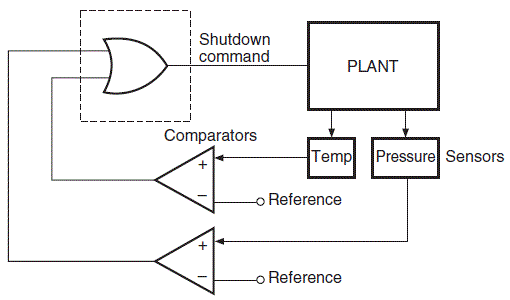
Applications of Logic Gates in Control Systems

Logic gates are made to make decisions based on the inputs obtained, this is when logic gates function as automatic switch.

There are three main components in a control system.

A. Input or Inputs   - consist of detectors which are able to detect changes (light, electrical, sound etc)
B. Control circuit    - electronic devices (capacitors, diodes and transistors)
C. Outputs              - devices (sirens, bulbs, alarm, heater, electric motors)

Some examples are

1. Control system for cooling fans
2. Fire control system
3. Temperature control system
4. Car theft alarm system

Image result for applications for logic gates
https://image.slidesharecdn.com/25-141106225713-conversion-gate01/95/69application-of-logic-gates-4-638.jpg?cb=1415314801

Image result for applications for logic gates
https://www.electrical4u.com/electrical/wp-content/uploads/2013/08/application-of-OR-gate.gif

Image result for applications for logic gates
https://qph.fs.quoracdn.net/main-qimg-186dbb7c7306f00e092e8f110928206c.webp


Analysing Logic Gates

A logic gate is a switching circuit that is applied in computers and other electronic devices and its a basic electronic building block used in computers and many digital devices.

This logic gate is responsible for performing logical operations in digital systems. The digital system involves two outputs inputs and output which involve two levels of voltage either high (1) or low (0).

The logic gates are named 'gates' because they give a '1'  on the output only when a particular combination of 1 and 0 is present at the inputs.

Logic Gates as Switching Circuits

A logic gate is a switching circuit made up of a combination of transistor switches. It has one or more input terminals but only one output terminal. It's useful to find out how come simple logic gates can be built from switches. Normally, a closed switch is considered to be at a high state (1) and and open switch low state (0). Switches in series can perform and AND gate function and switches in parallel can perform and OR gate function.

Types of logic gates:

1. NOT gate
2. AND gate
3. OR gate
4. NAND gate = AND and NOT gates
5. NOR gate = OR and NOT gates

The NOT, AND and OR gates are the three basic logic gates. All other more sophisticated gates are made from these gates by combining these gates in specific ways.

Image result for logic gates
https://physicsabout.com/wp-content/uploads/2018/02/logic-gates-min.png


2019-08-18

Applications of Cathode Ray Oscilloscope

There are several applications of CRO, namely:

1. Measuring the potential difference of a d.c.supply
2. Measuring the potential difference of an a.c. supply
3. Measuring a short duration of time
4. Measuring wave frequency
5. Displaying different wave forms

How energy of electrons is converted in Cathode ray tube

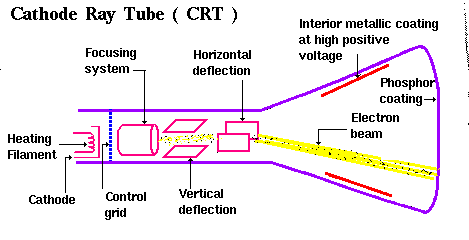
Below are samples of Cathode ray tube diagram

Image result for cathode ray tube
Reference: https://www.semanticscholar.org/paper/Simulation-of-cathode-ray-tube-Maiti-Rajagopal/ca0d214bf66cd8a3f01d175e0455dcc37deb71f4/figure/0


Reference: https://www.javatpoint.com/fullformpages/images/crt.gif


As electric current pass through the filament, it heats up and emits electron. This means electrical energy is converted to heat energy. The difference in electrical energy potential from anode and cathode increases the acceleration of electrons towards the fluorescent screen. This means electrical potential energy is converted kinetic energy of electrons. The high speed electrons then smash the screen and produce flourescence (light).

So that means electrical potential energy = kinetic energy

eV = 1/2 mv^2

electron charge, e = 1.6 x 10 ^ -19 C
electron mass, m = 9.1 x 10 ^ -31 kg
v = final velocity of electron

v^2 = 2eV/m

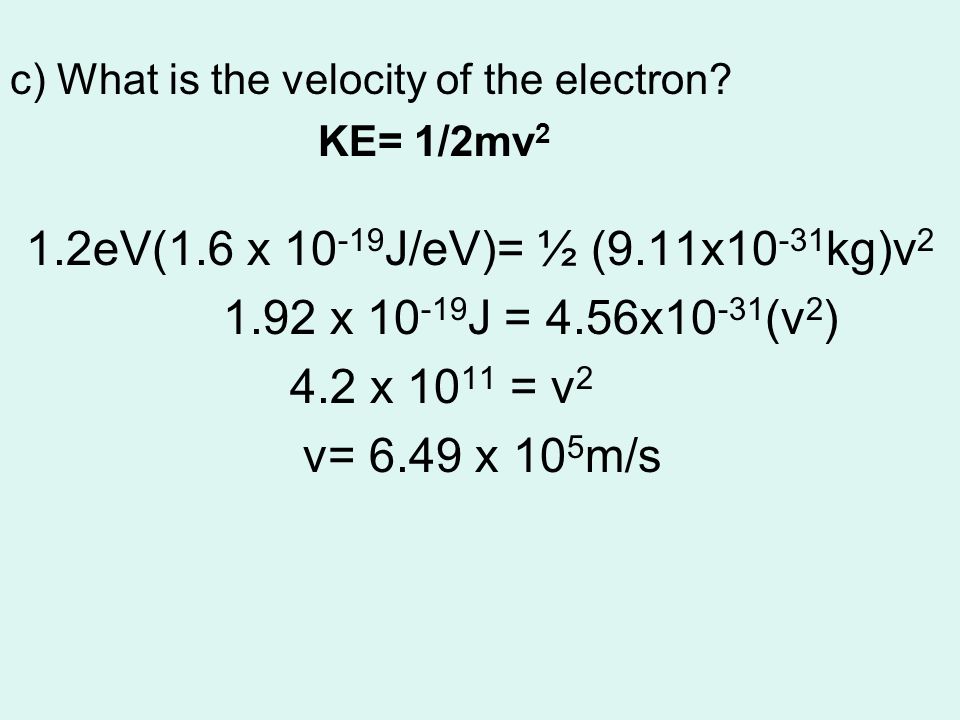
Example of question:

KE = 1.2eV


Reference: https://images.slideplayer.com/39/10862668/slides/slide_5.jpg


2015-03-22

Resolution of Forces

We know that two forces when combined together will form a single resultant force. On the other hand, a single force can be divided or broken up into two components.

The reversal of this process is called the resolution of forces. A force is usually resolved into two components that are perpendicular to each other.

A force can be resolved into two component forces graphically or by using trigonometry.

Image result for resolution of forces

Consider the diagram above. In the diagram the force F is resolved into two perpendicular component forces that is the Fy and Fx components (using parallelogram method).

To calculate the magnitude of the vertical (Fy) and horizontal (Fx) forces, we can use simple trigonometry.

Fx =  F cos Î¸ , Since cos Î¸ = (Fx/F)

Fy = F sin Î¸, Since sin Î¸ = (Fy/ F)

Examples of calculation:

By using the diagram above, Let say F = 80 N and Î¸ = 30 degree

The horizontal component Fx,
= F cos Î¸
= 80 cos 30
= 80 X 0.866
= 69.3 N to the right

The vertical component Fy,
= F sin Î¸
= 80 sin 30
= 80 x 0.5
= 40 N upwards

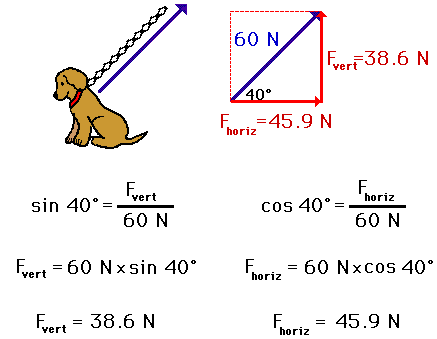
Another example would be as below:


Source: imgkid.com

Another good example:


Source: Physicsclassroom.com


2014-12-08

Resultant Force II

For the resultant force of two perpendicular forces, we need to consider other methods.

In this situation, two non-parallel forces are acting on an object at a right angle to each other.


So with the example above, there is Force a (Sometimes called component a) and Force b (sometimes called component b).

The resultant force is named as F.

The resultant force can be obtained through Phytogras theorem

F^2 = a^2 + b^2

F = Square root of (a^2+b^2)


Example of question:

What is the resultant force if Force a,70N  and Force b, 90N act on an object and both for the forces are perpendicular to each other. What is the direction of the force?

i. Resultant force, Fr = Square root of (70^2 + 90^2)
                                  = 114N

ii. Direction, Tan (theta) = 70 / 90
                                        = 0.7778
                                        = 37.9 degree

So the resultant force is 114N and the direction is 37.9 degree from the original 90N force.

If you have known the basic principle.
The questions can be manipulated but you can still know how to work out the question.


2014-09-14

Resultant Force I

1. Resultant force for two parallel forces

How to find the resultant force for two parallel forces?

If the forces are moving in the same direction. The resultant force is also in the direction of both forces. you have to ADD the magnitude of the two forces.


If the forces are moving in opposite direction, The direction of the resultant force is the same as the larger force. Subtract the magnitude of the lesser force by the larger force.


In the above example the resultant force is 1N in the direction of the larger force which is the 4N.

2. Resultant force of Two Non-Parallel Forces

When there are forces that moves in a non-parallel manner, simple calculation cannot be done to find the resultant force. What we can do is draw a scaled diagram.

Either by using the Triangle method


or the Parallelogram method


or more specifically


In the example above, let say if we put 100N = 2 cm.

F2 = 8 cm
F1 = 10 cm

You have to measure the angle carefully using a protractor to measure the angle between the two forces. The resultant force is the R which you can measure using a ruler and convert it back to the actual magnitude (e.g. if the resultant force is 12 cm then it would convert to 600 N)! The angle is the angle between R and F1.

Can you find the resultant force for this one?