2019-08-18

How energy of electrons is converted in Cathode ray tube

Below are samples of Cathode ray tube diagram

Image result for cathode ray tube
Reference: https://www.semanticscholar.org/paper/Simulation-of-cathode-ray-tube-Maiti-Rajagopal/ca0d214bf66cd8a3f01d175e0455dcc37deb71f4/figure/0
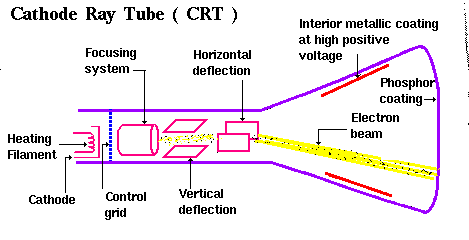


Reference: https://www.javatpoint.com/fullformpages/images/crt.gif


As electric current pass through the filament, it heats up and emits electron. This means electrical energy is converted to heat energy. The difference in electrical energy potential from anode and cathode increases the acceleration of electrons towards the fluorescent screen. This means electrical potential energy is converted kinetic energy of electrons. The high speed electrons then smash the screen and produce flourescence (light).

So that means electrical potential energy = kinetic energy

eV = 1/2 mv^2

electron charge, e = 1.6 x 10 ^ -19 C
electron mass, m = 9.1 x 10 ^ -31 kg
v = final velocity of electron

v^2 = 2eV/m

Example of question:

KE = 1.2eV
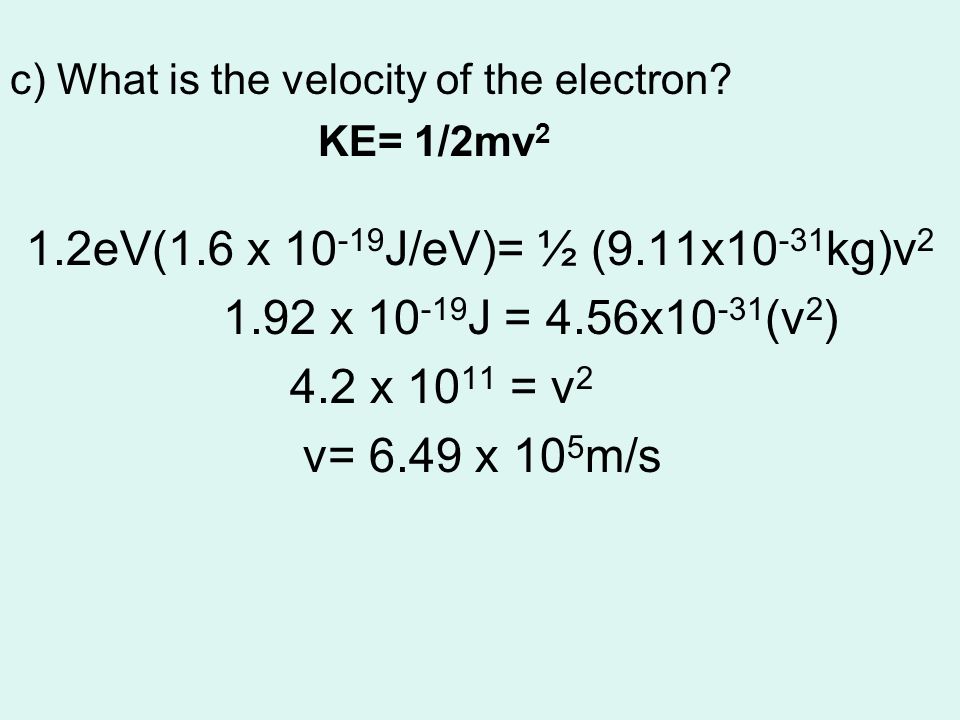

Reference: https://images.slideplayer.com/39/10862668/slides/slide_5.jpg


2015-03-22

Resolution of Forces

We know that two forces when combined together will form a single resultant force. On the other hand, a single force can be divided or broken up into two components.

The reversal of this process is called the resolution of forces. A force is usually resolved into two components that are perpendicular to each other.

A force can be resolved into two component forces graphically or by using trigonometry.

Image result for resolution of forces

Consider the diagram above. In the diagram the force F is resolved into two perpendicular component forces that is the Fy and Fx components (using parallelogram method).

To calculate the magnitude of the vertical (Fy) and horizontal (Fx) forces, we can use simple trigonometry.

Fx =  F cos θ , Since cos θ = (Fx/F)

Fy = F sin θ, Since sin θ = (Fy/ F)

Examples of calculation:

By using the diagram above, Let say F = 80 N and θ = 30 degree

The horizontal component Fx,
= F cos θ
= 80 cos 30
= 80 X 0.866
= 69.3 N to the right

The vertical component Fy,
= F sin θ
= 80 sin 30
= 80 x 0.5
= 40 N upwards

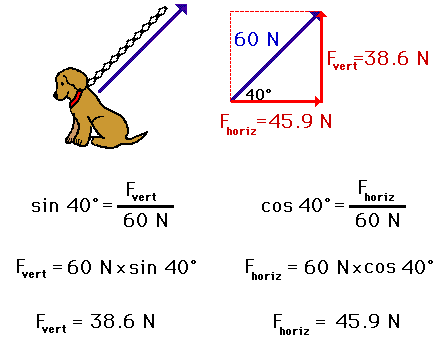
Another example would be as below:


Source: imgkid.com

Another good example:


Source: Physicsclassroom.com


2014-12-08

Resultant Force II

For the resultant force of two perpendicular forces, we need to consider other methods.

In this situation, two non-parallel forces are acting on an object at a right angle to each other.


So with the example above, there is Force a (Sometimes called component a) and Force b (sometimes called component b).

The resultant force is named as F.

The resultant force can be obtained through Phytogras theorem

F^2 = a^2 + b^2

F = Square root of (a^2+b^2)


Example of question:

What is the resultant force if Force a,70N  and Force b, 90N act on an object and both for the forces are perpendicular to each other. What is the direction of the force?

i. Resultant force, Fr = Square root of (70^2 + 90^2)
                                  = 114N

ii. Direction, Tan (theta) = 70 / 90
                                        = 0.7778
                                        = 37.9 degree

So the resultant force is 114N and the direction is 37.9 degree from the original 90N force.

If you have known the basic principle.
The questions can be manipulated but you can still know how to work out the question.